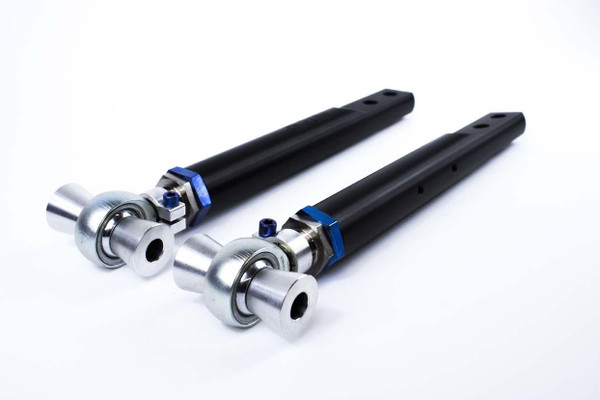
Installation of new tie rods. 

First remove the safety pin and nut from the outer tie rod ends, and pull it off the spindle:

Pull back the steering rack boot, and pry back the 4 locking tabs on the inner tie rod.  Using a large wrench, hold the inner tie rod on the squared sides, and loosen (counter-clockwise) and remove.

Slide on new locking washer.  Note:  If using steering angle spacers, omit the locking washer

Install new inner tie rods.  Note:  If installing steering angle spacers, slide the spacers on the inner tie rods first, then apply blue loctite to threads before installing tie rods onto the steering rack.

Using a punch, indent the locking washer at the appropriate spot on the steering rack.  Note: Omit this step if locking washer was not installed to accommodate steering angle spacers.

Slide on and install steering rack boots, and jam nut for inner tie rods.


Pre-installation setup of outer tie rod ends

If using Z32 inner tie rods, set outer tie rod ends so the rod end is fully threaded into the buckle.

If using Z33 inner tie rods, set outer tie rod ends so the length measures 5.25" from end of buckle to center of spherical bearing.


Installation of outer tie rod ends.

Insert shank into spindle, with washer and thread on the locking nut.  Use the 2 supplied gold colored nuts on the bottom half of the shank, jam the 2 nuts together to provide a way to hold the shank.  Holding on to the shank using the hold nuts, torque the top nut to 40 ft-lbs.  It is critical that the nut is not over-torqued or the strength of the tie rod end will be severely compromised.

Remove the 2 gold colored nuts.

Install spacers -- pictured below, the tie rod ends are installed with 1 adjustment spacer (flat ring spacer) and 1 misalignment spacer (larger cone shaped spacer).  For most installations with stock front lower control arms, we recommend using only the misalignment spacer and no adjustment spacers, for best suspension geometry and maximum strength. 

Install locking nut on bottom.  This nut may take some effort to thread as it is a metal crimping/locking nut.  Thread the locking nut to the point where the tie rod end assembly is snug, ie. there should be no movement possible on the spacers and rod end.  Torque to 30 ft-lbs.

Check for binding or any problems by rotating steering wheel lock to lock.  Check that the spherical bearing does not bind (the edge of the ball bearing hitting or close to hitting the housing) under any situation as shown in the picture below.

Note that the inner tie rod end can rotate freely, so the following is not binding even though the edge of the ball is touching the housing.  If uncertain, try rotating the inner tie rod by using a wrench on the hex part of the inner tie rod:

Tighten down the 2 jam nuts that go against the hex buckle of the outer tie rod end.

When getting the car aligned, please adjust toe by turning the inner tie rod.  Do not turn the tie rod end buckle, this will not adjust toe.


Length adjustment of outer tie rod ends

In certain cases (eg. if you have a widened track width using adjustable lower arms) it may be necessary to make the outer tie rod ends longer.  The outer tie rod ends can be lengthened without removal using the following procedure:

Loosen the jam nuts on both sides of the hex buckle.

Turn the hex buckle so as to thread out the rod end (spherical bearing side).  Note that since both the rod end and the inner tie rods are right hand thread, threading out the rod end will in turn thread in the buckle on the inner tie rod side.

Note that for safe thread engagement, the maximum amount of exposed thread on the rod end should not exceed 0.7".

Once the outer tie rod end is long enough, tighten down jam nut on the rod end side.  Now turn the inner tie rod to adjust the toe.

Some pictures used in this installation are courtesy of Robin Webber.
Instructions and other pictures are copyright SPL PARTS INC., Nov 15 2007